
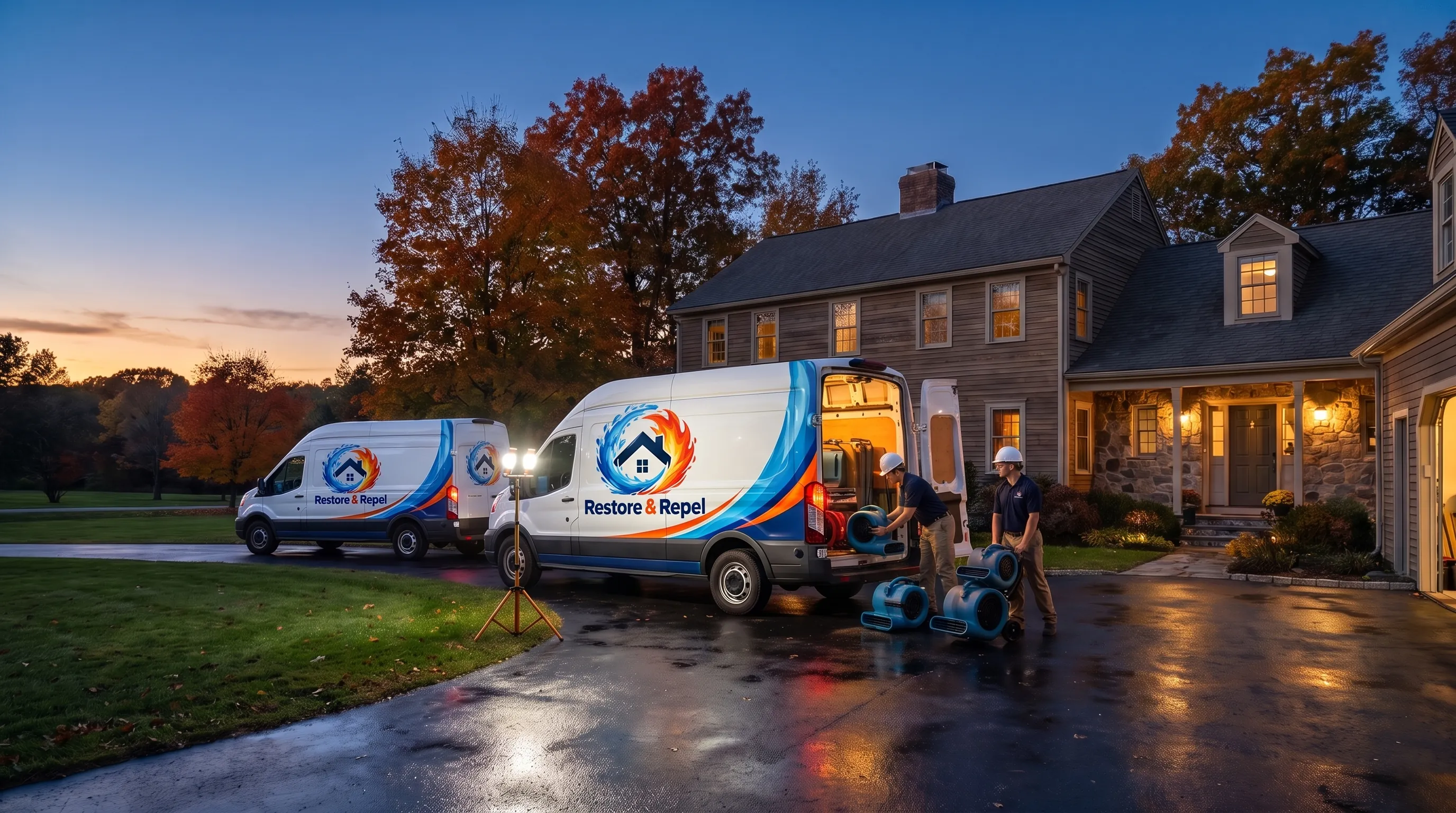
TL;DR: In Massachusetts, water damage restoration typically costs $1,200 to $15,000 or more, depending on how much water, how contaminated it is, and how far it traveled before anyone noticed. A single wet room with clean water runs toward the low end. A flooded basement with sewage or a whole-floor loss runs toward the high end. Most homeowners policies cover sudden, accidental water damage, but flood and sewer backup usually need separate coverage.
If you’re standing in a wet basement in Topsfield or Peabody right now, pricing is probably the second thing on your mind after “how do I stop this.” Here’s what restoration actually costs in Massachusetts, what changes the number, and what your insurance is likely to pay for.
How Much Does Water Damage Restoration Cost in Massachusetts?
Most Massachusetts homeowners pay between $1,200 and $15,000 for water damage restoration, with the final number set by how much water came in, how contaminated it was, and how long it sat before drying started. A small, clean-water leak caught the same day is a different job than a basement that sat flooded for 48 hours.
Here’s a rough breakdown by scenario, based on typical industry pricing across the region:
| Scenario | Typical Cost Range |
|---|---|
| Single room, clean water (Category 1), caught quickly | $1,200 - $3,500 |
| Multiple rooms, gray water (Category 2, appliance or washer discharge) | $3,500 - $7,500 |
| Flooded basement, structural drying, dehumidification | $5,000 - $12,000 |
| Black water loss (Category 3, sewage backup or storm flooding) | $7,000 - $15,000+ |
| Water damage with mold growth already present | $8,000 - $20,000+ |
| Drywall, flooring, or trim replacement after drying (per affected room) | $2,000 - $6,000 |
These are typical ranges, not a quote. Every loss is different, and Restore & Repel provides a written scope of work before any work begins so there are no surprises on the invoice.
What Drives the Cost Up or Down?
The biggest cost driver is how contaminated the water was and how long it sat, which together determine how much material has to be removed instead of dried in place. Clean water from a supply line, caught within hours, can often be dried in place. Water that sat for days, or came from a drain, almost always means tearing out wet drywall, insulation, and flooring.
A few other factors that move the number:
- Square footage and number of rooms affected. More wet floor area means more air movers, more dehumidifier capacity, and more labor hours.
- Category of water under the ANSI/IICRC S500 standard: Category 1 (clean), Category 2 (gray water, like dishwasher or washing machine discharge), or Category 3 (black water, including any sewer backup, toilet overflow with waste, or storm flooding). Category 3 always requires antimicrobial treatment, PPE, and removal of porous materials. It costs more because the work is more intensive, not because the company charges more for the same job.
- What’s underneath the water. Hardwood floors, plaster walls, and finished basements in older New England homes, common around Topsfield and the North Shore, take longer to dry and sometimes can’t be saved.
- How fast mitigation started. Mold can begin growing on wet materials within 24 to 48 hours (EPA). A delay of even a day or two can turn a drying job into a drying-plus-mold-remediation job, which is why response time matters more than people expect.
- Reconstruction needs. Drying and extraction are one line item; replacing drywall, trim, subfloor, and flooring is a separate scope, often handled by the same crew for continuity.
Will Homeowners Insurance Cover the Cost?
Most homeowners policies cover sudden, accidental water damage, such as a burst supply line or a water heater that fails without warning, but they generally exclude gradual leaks, flooding, and sewer backups unless you’ve added specific coverage. Reading your declarations page before you assume anything is covered will save you a painful conversation later.
Here’s the general pattern insurers follow, per the Insurance Information Institute:
- Usually covered: a pipe that suddenly bursts, an appliance hose that fails, a water heater that ruptures.
- Usually NOT covered without an endorsement: sewer or drain backups, and sump pump failure or overflow. These need a water backup (sewer/sump) endorsement added to the policy. Don’t assume a backed-up floor drain is covered just because the water came from inside the house.
- Not covered at all under a standard homeowners policy: flooding from rising water, storm surge, or overflowing rivers and streams. That requires a separate flood policy through the National Flood Insurance Program or a private flood carrier.
- Gradual damage and poor maintenance: a slow leak behind a wall that’s been dripping for months is typically denied as a maintenance issue, not a sudden loss.
Documentation protects the claim. Photograph the damage before anything is moved, keep every receipt, and get mitigation started promptly since you have a duty to limit further damage. Restore & Repel documents moisture readings, photos, and scope of work as the job progresses, which is exactly what adjusters ask for. For a deeper look at what’s typically covered, see our guide on does homeowners insurance cover water damage.
What Happens During a Water Damage Restoration Job?
A typical job runs through four phases: inspection and water categorization, extraction, structural drying, and repair. Each phase has its own equipment and its own line item on the invoice.
- Inspection and moisture mapping. A technician identifies the water category, checks for electrical hazards, and uses a moisture meter to map how far the water traveled behind walls and under flooring, often farther than it looks from the surface.
- Extraction. Standing water comes out first, using truck-mounted or portable extraction equipment. This is the fastest way to stop ongoing damage to flooring and subfloor.
- Drying and dehumidification. Air movers and LGR dehumidifiers run for several days, following the drying standards in the IICRC S500. Daily moisture checks confirm materials are actually drying, not just feeling dry to the touch.
- Reconstruction. Anything that couldn’t be saved, drywall, insulation, flooring, gets replaced. This is where a company that also handles reconstruction and general contracting can close the loop without bringing in a second contractor.
If you’re in the middle of an active leak right now, our flooded basement checklist walks through what to do before help arrives.
Getting a written scope before work starts is the single best way to avoid a cost surprise. If you’re dealing with standing water in a basement or a slow ceiling stain that’s spreading, request an assessment so you know the category of loss and the real scope before anything gets torn out.
About Restore & Repel
Restore & Repel employs IICRC-certified technicians (WRT, FSRT, AMRT) serving Topsfield, Massachusetts and the North Shore since 2003, operating under Massachusetts license CS-113-396. Their crews handle water damage restoration, fire and smoke damage restoration, mold remediation, storm damage, odor removal, reconstruction, roofing, and general contracting across Topsfield, Peabody, Beverly, Danvers, Andover, and the surrounding region, with 24/7 emergency response.
Need help now? Call Restore & Repel at (800) 393-1532.