
Mold Remediation in Topsfield
24/7 mold remediation in Topsfield and surrounding areas. IICRC-certified, insurance billing accepted. Call (800) 393-1532.
A musty smell that shows up every time the furnace kicks on, a ceiling stain that keeps spreading after a roof patch, or a basement that never quite lost that damp-cardboard odor after last spring’s water intrusion: these are the signals that mold has moved past a surface issue and into something that needs to be contained, not just sprayed and painted over. Mold colonizes drywall paper and wood framing within 24 to 48 hours of sustained moisture, and by the time it’s visible on a wall, it’s usually established well behind it.
What mold remediation actually involves
Real mold remediation is not a bleach-and-fan job. It starts with identifying the moisture source, because treating mold without fixing the water problem behind it just buys a few months before it returns. From there, affected materials get isolated, air quality gets measured, and contaminated porous materials (drywall, insulation, carpet padding, sometimes subfloor) get removed rather than just cleaned, since mold hyphae grow into porous surfaces in a way that surface cleaning can’t reach. Non-porous surfaces like framing lumber, concrete, and tile get HEPA vacuumed and treated with an EPA-registered antimicrobial. Timelines vary with square footage and how far the colonization has spread, but a contained single-room job typically runs a few days from setup to clearance, while a job involving HVAC contamination or crawlspace work takes longer.
Our process
- Assessment and moisture mapping. Before any containment goes up, we find where the water is coming from and use moisture meters to map how far it has traveled behind walls and under flooring.
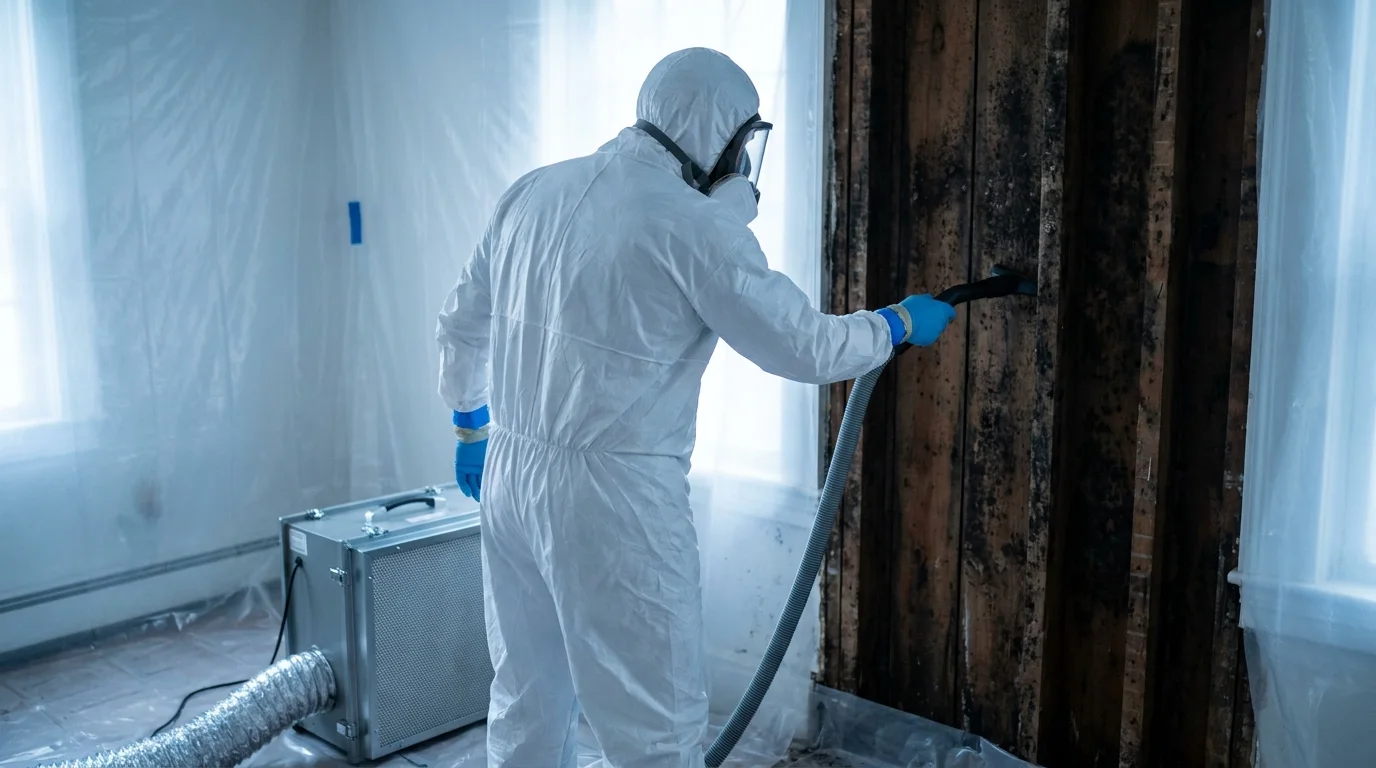
- Containment. For anything beyond a minor, isolated spot, we build physical barriers with negative air pressure to keep spores from migrating into unaffected rooms during the work. This is standard practice under the IICRC S520 mold remediation guideline.
- Air sampling. Baseline air samples (and sometimes surface samples) get taken before work begins, giving us a comparison point for clearance testing later.
- Removal and HEPA filtration. Contaminated materials are bagged and removed, surfaces are HEPA vacuumed, and HEPA air scrubbers run continuously to pull airborne spores out of the contained space.
- Clearance testing. After the space is treated and dried, a final air sample confirms spore counts are back to a normal range before containment comes down and the space is cleared for rebuild.
What separates a good mold remediation response from a bad one
The most common mistake is treating the mold without addressing the moisture source, whether that’s a slow roof leak, a leaking supply line, or grading that sends water toward the foundation. Spraying bleach on drywall and calling it done is another one: bleach kills surface mold but doesn’t penetrate porous material, and the chlorine smell can mask the problem without solving it. A second mistake is skipping containment on jobs that look small but aren’t, which lets spores spread through the HVAC system to rooms that were never contaminated to begin with. Insurance adjusters on mold claims typically want documentation of the originating water event, moisture readings, pre- and post-remediation air sample results, and a clear scope showing what was removed versus treated in place. Jobs that lack that paper trail are the ones that get disputed or underpaid.
What does mold remediation cost?
Cost depends on the square footage affected, whether the mold has reached framing or HVAC components, and how much containment the job requires. Every loss is different, which is why Restore & Repel provides a written scope of work before any remediation begins, based on the moisture mapping and visual inspection. Homeowners insurance typically covers mold remediation when it results from a sudden, covered water event like a burst pipe, but it often excludes mold from long-term leaks, humidity, or deferred maintenance, so it’s worth checking your policy’s specific mold endorsement.
| Scenario | Typical range |
|---|---|
| Small bathroom or closet, surface mold only | $500 - $1,500 |
| Single room, contained, with material removal | $1,500 - $4,000 |
| Basement or crawlspace remediation | $2,000 - $6,000 |
| Whole-house or HVAC contamination | $6,000 - $15,000+ |
| Air quality testing and clearance only | $300 - $900 |
Seasonal & regional considerations
North Shore summers bring enough humidity that basements and crawlspaces in older Topsfield and Essex County homes can sit above the moisture threshold mold needs for weeks at a time, especially in houses without dehumidification or with older fieldstone foundations that weep moisture. Winter brings the opposite risk: ice dams on pitched roofs common in this area’s older housing stock push meltwater back under shingles and into attic insulation and ceiling cavities, where it goes undetected until a stain appears on the drywall below.
Service area
Restore & Repel handles mold remediation for homeowners and property managers in Topsfield and throughout the surrounding North Shore towns, including Boxford, Middleton, Ipswich, and Wenham.
If you’re smelling something musty, seeing discoloration spreading on a wall, or just had a water event you’re worried wasn’t fully dried out, request an air quality test and get a clear answer on what’s actually in your walls before it spreads further.
Frequently Asked Questions
Does homeowners insurance cover mold remediation?
What level of mold remediation requires containment under the IICRC S520 standard?
Can mold be cleaned instead of removed?
How long does mold remediation take from start to clearance?
What happens during air sample clearance testing?
Looking for the best mold remediation company in Topsfield?
Restore & Repel provides licensed and insured mold remediation in Topsfield, MA and the surrounding area, and has served local property owners since 2003. Customers rate us 5.0 out of 5 stars across 2 Google reviews. We answer calls 24/7 — call (800) 393-1532 for immediate help.
Need Mold Remediation now?
We respond 24/7 across Topsfield and surrounding MA cities.
Related Coverage
- Our Restoration Services
- Contact Restore & Repel
- Mold Remediation in Andover
- Mold Remediation in Boxford
- Mold Remediation in Danvers
- Mold Remediation in Middleton
- Mold Remediation in North Andover
- Mold Remediation in Peabody
- How To Choose a Restoration Company in Topsfield (Without Getting Burned)
- How To Test for Mold in Your Home (DIY Kits vs a Pro Inspection)
- 7 Signs You Have Hidden Mold (and What To Do Next)
- Odor Removal and Deodorization in Topsfield
- Mold Remediation in Wakefield
- Best Mold Remediation Company in Topsfield, MA: How to Compare Your Options
- Mold Remediation Cost in Topsfield, MA: Real Price Ranges by Room and Size (2026)