
24/7 Emergency Flood Damage Restoration in Topsfield
24/7 emergency flood damage restoration in Topsfield and surrounding areas. IICRC-certified, insurance billing accepted. Call (800) 393-1532.
Flooding in your home right now? Call (800) 393-1532 for emergency service, we answer 24/7. Floodwater behaves differently than a burst pipe. It carries silt, runoff, and often contamination from storm drains or septic backup, and it tends to find its way into wall cavities, subfloor, and crawlspaces faster than homeowners expect. Within hours, drywall wicks water upward, engineered flooring swells, and the clock starts on mold colonization. Flood cleanup isn’t just extraction, it’s a documented, category-specific process that protects the structure and supports your insurance claim.
What flood damage restoration actually involves
Flood restoration starts with identifying the water category. Rainwater intrusion through a foundation crack is treated differently than water that’s backed up through a sewer line or picked up contaminants crossing a yard. That classification drives everything: what gets removed versus dried in place, what PPE the crew wears, and what documentation your adjuster will expect to see.
A typical residential flood job involves pumping or extracting standing water, removing saturated materials that can’t be safely dried (carpet pad, baseboards, sometimes drywall up to the flood line), and setting air movers and dehumidifiers calibrated to the room’s size and material mix. Moisture readings get logged daily, not estimated by eye, because insurance carriers want a drying log that shows the structure actually reached dry standard, not just that equipment ran for a few days.
Our process
- Water category assessment. We test and classify the water (clean, gray, or black) before deciding what’s salvageable.
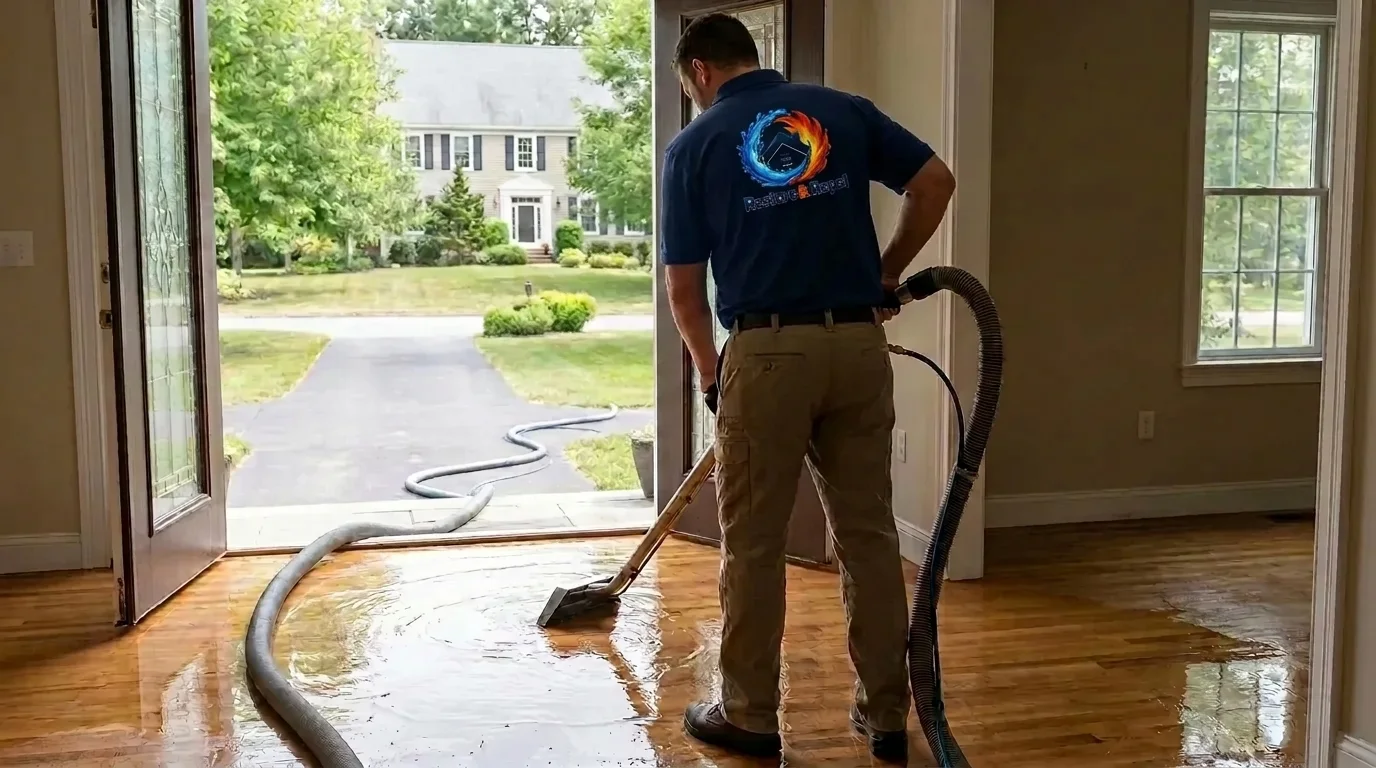
- Extraction. Truck-mounted or portable extraction removes standing water from flooring, carpet, and subfloor cavities.
- Controlled demolition. Saturated drywall, insulation, and flooring that can’t be dried in place are removed to the height the water reached, documented with photos for your claim.
- Drying and monitoring. Air movers, dehumidifiers, and daily moisture meter readings track progress against the IICRC S500 drying standard until materials read dry, not just damp.
- Containment for gray or black water. When sewage or runoff contamination is present, affected areas are contained and treated before reconstruction begins.
What separates a good flood damage response from a bad one
The most common mistake is treating every flood like a clean-water event. Drying a carpet that sat in sewage-contaminated runoff instead of removing it isn’t a shortcut, it’s a health risk and a reason adjusters push back on claims. A second mistake is skipping subfloor and wall cavity checks because the surface “looks dry” within a day or two. Flooring can read dry on top while the plywood underneath or the bottom plate of a wall stays saturated for a week, which is exactly the setup for hidden mold growth months later.
Good operators also document as they go, moisture logs, photos before demolition, and a written scope, because that paper trail is what gets claims paid without delay. Adjusters specifically look for category classification, daily drying readings, and proof that contaminated materials were disposed of rather than dried and reinstalled.
What does flood damage restoration cost?
Costs vary with water category, how much material has to be removed, and how many rooms are affected. These are typical industry ranges, not a quote, every loss is different, and Restore & Repel provides a written scope before any work begins. Homeowners insurance typically covers sudden, accidental flooding events like a burst pipe or storm-driven water intrusion, though standalone flood damage from rising groundwater or overflowing waterways usually requires separate flood insurance, which is worth confirming with your agent before work starts.
| Scenario | Typical range |
|---|---|
| Single room, clean water, no demolition | $1,200 - $3,500 |
| Multiple rooms, clean to gray water | $3,000 - $8,000 |
| Whole-floor flooding with flooring/drywall removal | $8,000 - $20,000 |
| Black water or sewage-contaminated flooding | $10,000 - $25,000+ |
| Basement flood with finished walls and flooring | $5,000 - $15,000 |
Seasonal & regional considerations
Northeastern Massachusetts sees two distinct flood risk windows: spring snowmelt combined with heavy rain, which overwhelms older storm drains and saturates ground that’s still partially frozen, and late-summer tropical remnants that can drop several inches of rain in a short window. Older housing stock in this region, much of it built with fieldstone or poured concrete foundations from decades past, is more prone to groundwater seepage during these events than newer construction with modern waterproofing. Basements and below-grade additions are the first place to check after any significant rain event.
Service area
Restore & Repel is based in Topsfield and responds to flood damage throughout the surrounding Essex County communities. If you’re searching for flood cleanup outside Topsfield itself, our city-specific pages cover local drainage patterns and typical housing stock in more detail.
If water is actively rising or has already soaked into flooring and walls, don’t wait for it to “dry out on its own.” Schedule your flood damage assessment now and get a documented drying plan started before mold has a chance to take hold.
Frequently Asked Questions
Does homeowners insurance cover flood damage restoration?
How do you decide what gets thrown away versus dried in place?
How long does flood damage drying typically take?
Is it safe to stay in the house after a flood?
What should I do while waiting for a flood restoration crew to arrive?
Looking for the best flood damage restoration company in Topsfield?
Restore & Repel provides licensed and insured flood damage restoration in Topsfield, MA and the surrounding area, and has served local property owners since 2003. Customers rate us 5.0 out of 5 stars across 2 Google reviews. We answer calls 24/7 — call (800) 393-1532 for immediate help.
Need Flood Damage Restoration now?
We respond 24/7 across Topsfield and surrounding MA cities.
Related Coverage
- Our Restoration Services
- Contact Restore & Repel
- 24/7 Emergency Water Damage Restoration in Topsfield
- 24/7 Emergency Water Removal & Cleanup in Topsfield
- 24/7 Emergency Basement Flooding Cleanup in Topsfield
- 24/7 Emergency Burst Pipe Cleanup and Repair in Topsfield
- 24/7 Emergency Ceiling Water Damage Repair in Topsfield
- 24/7 Emergency Water Damage Restoration in North Andover
- 24/7 Emergency Water Damage Restoration in Peabody
- The 5 Best Water Damage Restoration Companies in Topsfield, MA (2026)
- What To Do in the First 24 Hours After Water Damage