
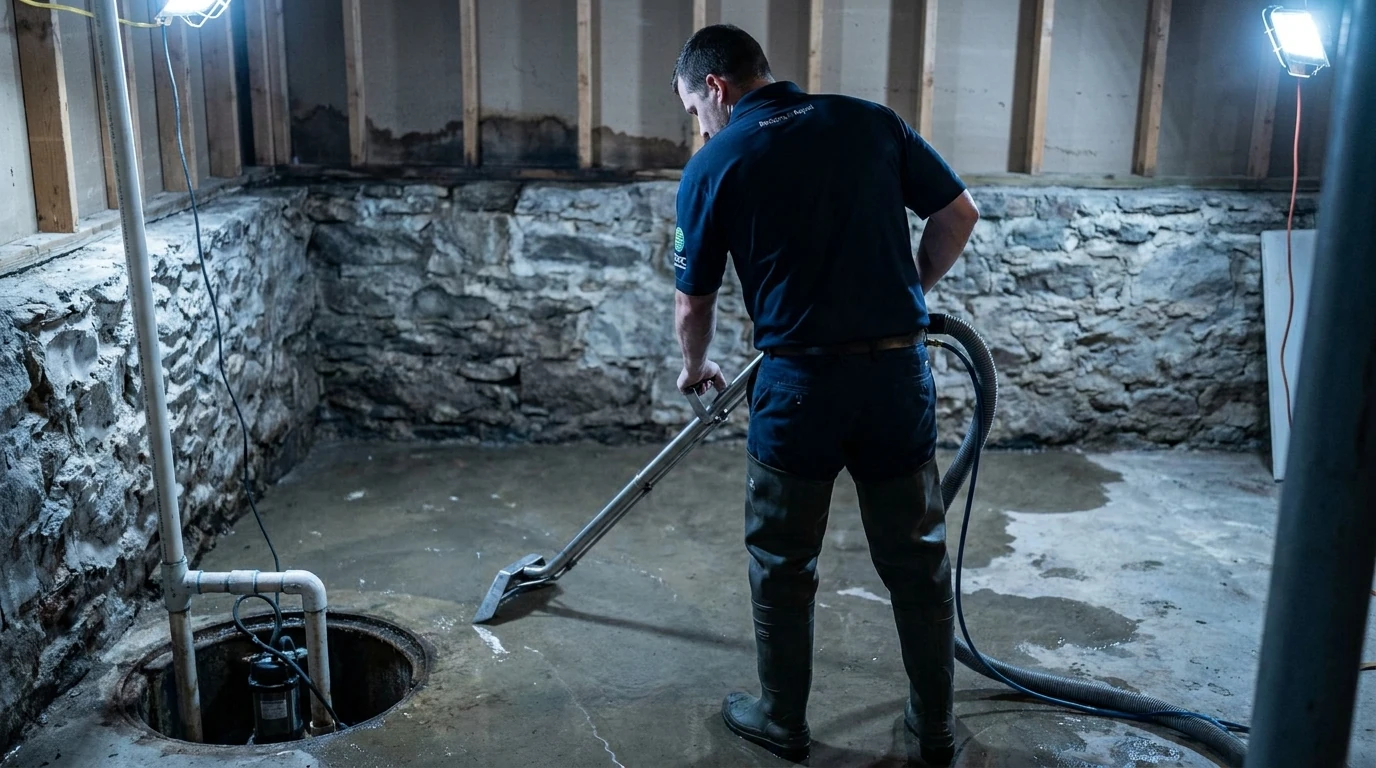
TL;DR: For a flooded basement in Topsfield, call a licensed water damage restoration company first, not your insurer and not a general plumber, unless the water source is still actively running from a fixable pipe or fixture. A restoration crew stops the clock on mold growth, documents the loss for your claim, and coordinates any plumbing repair the basement actually needs. Call your insurance company after mitigation starts, not before.
If the sump pump alarm just went off, or you walked downstairs to find an inch of water creeping across the slab, you don’t have time to research five companies. Call a licensed water damage restoration company at (800) 393-1532 (Restore & Repel serves Topsfield and the North Shore 24/7) and start pulling valuables off the floor while the phone rings. That single call covers extraction, drying, and the insurance paperwork that follows. A plumber only enters the picture if the water is still actively flowing from a pipe, fixture, or fitting that needs physical repair.
Do I call a plumber or a restoration company first?
Call the restoration company first unless water is actively pouring from a broken pipe or fitting right now, in which case shut off the water at the main and call a plumber for that specific repair. Most basement floods in Topsfield come from sump pump failure, groundwater intrusion, or a saturated yard, not a burst supply line, so there’s nothing for a plumber to fix until the water stops coming in on its own.
Topsfield sits on a high water table near the Ipswich River, and a lot of homes here run on private wells with basement sump systems doing constant work. When a pump fails during spring snowmelt or a fall nor’easter, water keeps rising until the pump is replaced or the storm passes, not because a pipe is leaking. In that scenario, a plumber can swap the pump, but someone still has to extract the standing water, pull the wet baseboard and insulation, and dry the structure before mold sets up. That’s restoration work, not plumbing work, and it needs to start within hours, not days.
If the flooding is from a sewer backup or a failed sump that’s also backing up a floor drain, that’s Category 3 water, often called black water, meaning it carries contaminants, requires antimicrobial treatment, and needs more material removed rather than dried in place under the ANSI/IICRC S500 standard for professional water damage restoration, not shop-vacced by hand.
What should I do in the first 30 minutes, before anyone arrives?
Shut off power to the affected area at the breaker if there’s any standing water near outlets or appliances, then stay out of the basement until a professional confirms it’s safe. Electrocution risk is the one thing worth stopping to think about before you grab anything else.
After that:
- Move boxes, electronics, and anything irreplaceable off the floor and onto shelving or upstairs.
- Take photos and a short video of the water level and anything damaged, before you touch or move it, for the insurance claim.
- If you can safely reach it, check whether the sump pump is running or silent. A silent pump during active flooding usually means pump failure, not just overwhelmed capacity.
- Don’t run a shop vac on more than an inch or two of water. It’s slow, it won’t reach under flooring, and it won’t dry the framing behind the walls.
Our burst pipe emergency checklist covers the same shutoff-and-document steps in more detail if the source turns out to be a supply line rather than groundwater.
What happens when the restoration company gets there?
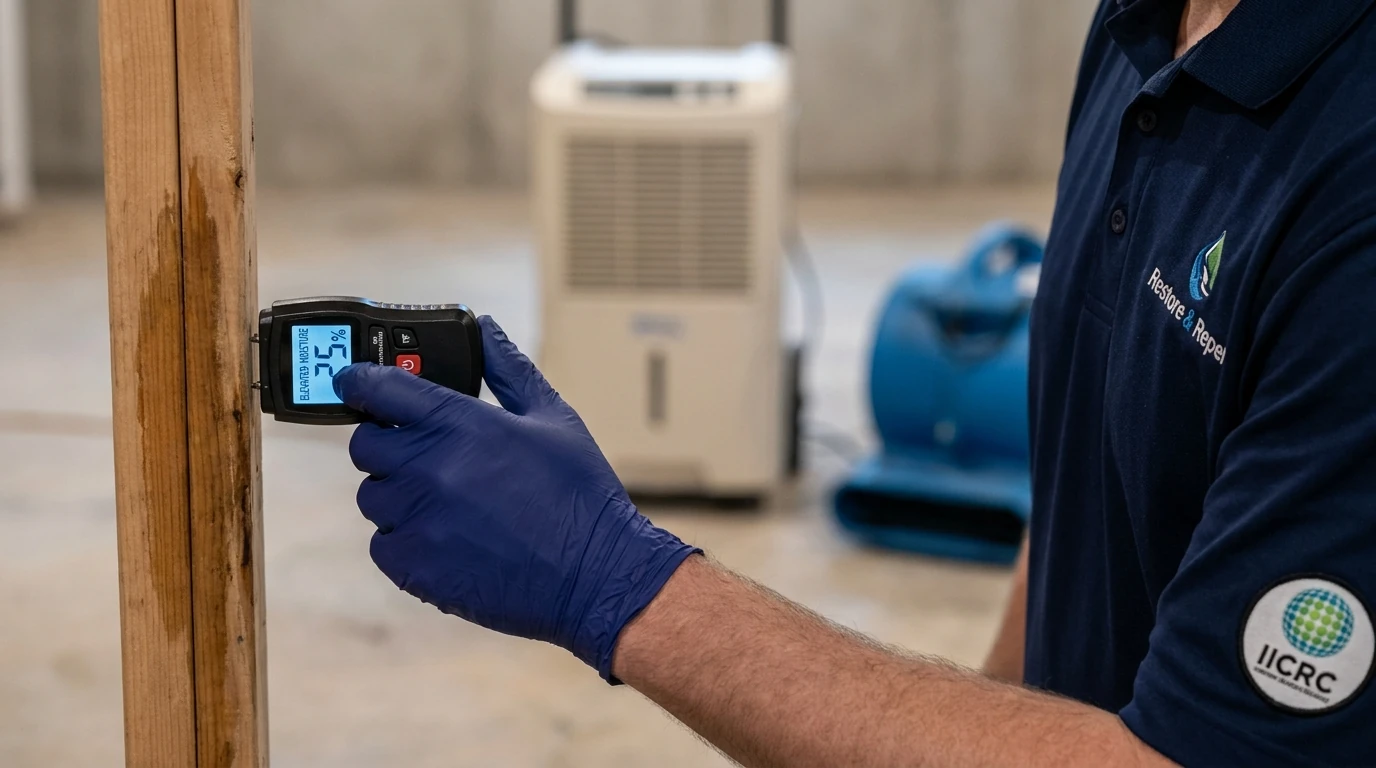
A restoration crew arrives with truck-mounted extraction equipment, pulls the standing water first, then uses moisture meters to map how far the water traveled into drywall, subfloor, and framing you can’t see from the surface. That mapping is what determines what gets dried in place versus what has to come out.
Expect the crew to set air movers and a dehumidifier running within the first visit, document the affected square footage and materials with photos, and give you a written scope before any demolition starts. If the water sat for more than 24 to 48 hours, or it’s Category 3 water from a sewage or drain backup, visible drywall and insulation below the waterline are usually removed rather than dried, since porous material that’s absorbed contaminated water doesn’t dry clean. Our basement flooding cleanup service and emergency water removal crews both run this same sequence: extract, assess, document, dry.
Wet basements left untreated grow visible mold in as little as 24 to 48 hours in the right conditions, according to the EPA’s mold cleanup guidance, which is the real reason the restoration call comes before the insurance call. Waiting two or three days to “see if it dries on its own” is usually what turns a water claim into a mold remediation job.
Will my homeowners insurance cover this?
Most homeowners policies cover sudden water damage, like a burst supply line, but typically exclude a failed sump pump unless you’ve added a separate sewer/sump water backup endorsement, and also exclude water that enters from outside the foundation, such as surface flooding or a rising water table, unless you carry separate flood or water backup coverage. The distinction between “sudden and accidental” and “gradual or external” is where most basement claims get contested, so documentation matters more here than in almost any other water loss.
Our full breakdown of what homeowners insurance covers walks through the sudden-versus-gradual distinction that determines whether a basement claim gets paid. A restoration company that photographs the loss, logs moisture readings daily, and writes a detailed scope before demolition gives your adjuster something concrete to approve, instead of a verbal description after the fact.
If the basement has flooded before, or the water sat long enough that you’re noticing a musty smell, it’s worth having it checked for hidden mold behind the baseboard or under flooring even after the structure looks dry. Mold remediation is a separate scope of work from water extraction, and catching it early keeps it that way.
Once the water is out and the drying equipment is running, the next move is a written moisture log and a clear scope of repair, whether you’re filing a claim or paying out of pocket. Ask for both before anyone signs off on the job as done.
About this guide: Restore & Repel employs IICRC-certified technicians (WRT, FSRT, AMRT) based in Topsfield, Massachusetts, operating under Massachusetts license CS-113-396 and serving the North Shore since 2003. Their crews handle water damage restoration, basement flooding cleanup, mold remediation, fire and smoke restoration, and reconstruction across Topsfield, Peabody, Beverly, Danvers, and surrounding communities.
Need help now? Call Restore & Repel at (800) 393-1532.