
If a pipe bursts, an appliance fails, or a storm drives rain through your roof, most standard homeowners insurance policies will cover the resulting water damage, as long as it happened suddenly and by accident. What they typically will not cover is damage from something that was building for months, like a slow roof leak you never fixed, worn-out supply lines, or water that rises up from outside the home (that’s flood damage, and it needs a separate policy). The difference between “sudden and accidental” and “gradual or preventable” is the single biggest factor an adjuster weighs, and it’s worth understanding before you ever file a claim.
The Line Insurers Actually Draw
Homeowners policies are built around the idea of discrete, accidental events. A supply line to the washing machine splits open overnight and floods the laundry room: covered. A dishwasher hose that’s been seeping behind the cabinet for a year, warping the subfloor: likely denied, because the policy treats that as a maintenance failure, not an accident. Insurers use terms like “sudden and accidental” versus “wear and tear” or “lack of maintenance,” and the wording in your specific policy matters more than general rules of thumb.
A few scenarios that typically fall on the covered side:
- A frozen pipe bursts during a cold snap (common in New England homes with exterior walls or unheated crawlspaces)
- A water heater tank fails and empties onto the basement floor
- Wind-driven rain or ice damming forces water through the roof during a storm
- A toilet supply line or wax ring fails and overflows
Scenarios that usually fall outside standard coverage:
- Water table or groundwater seeping through a foundation over time
- Storm surge, river flooding, or heavy rain pooling and entering at grade (flood insurance territory)
- Damage traced to a roof that was known to be failing and never repaired
- Mold or rot that developed from a leak the homeowner knew about and ignored
If you’re unsure which category your situation falls into, that uncertainty alone is a reason to get a professional assessment before you call your carrier, not after.
What To Do The Moment You Find Water
- Stop the source if you can do it safely. Shut off the main water valve for a plumbing failure, or the valve under the fixture if it’s isolated to one appliance.
- Cut power to the affected area if water is anywhere near outlets, switches, or a breaker panel, especially in a basement.
- Photograph everything before you touch it. Standing water, soaked baseboards, swollen drywall, the appliance or pipe that failed. Insurers want to see the loss as it happened, not after it’s been cleaned up.
- Start removing standing water with a wet-dry vac or towels if it’s manageable, but don’t move heavy saturated furniture or pull up flooring yourself. That can push water deeper into subfloor and framing.
- Note the time and likely cause while it’s fresh. Was the furnace off? Had a storm just passed? Did you hear the pipe go? This detail matters later.
- Call your insurance company to start the claim, ideally the same day. Most policies require “prompt notice,” and waiting can be used against you even on an otherwise covered loss.
What Not To Do
- Don’t wait to see if it dries on its own. Drywall and subfloor that stay wet past roughly 24 to 48 hours are the window where mold colonization becomes a real risk, and a delayed response can shift an adjuster’s read on whether the damage was “sudden” or allowed to worsen through inaction.
- Don’t throw away damaged items before documenting them. Set wet items aside, photograph them, and ask your adjuster what they need before anything goes to the curb.
- Don’t assume your contractor and your insurer are on the same page. Get the scope of work and the claim estimate in writing, and ask your restoration company to document moisture readings as they go, not just at the start and end.
- Don’t skip the maintenance history question. If an adjuster asks when you last had the roof inspected or the water heater serviced, answer honestly. Inconsistencies are a faster way to lose a claim than the damage itself.
When To Call In a Restoration Professional
A shop vac and a box fan can handle a small spill. They can’t handle water that’s gotten into wall cavities, under hardwood, or into a finished basement, and they definitely can’t tell you whether your subfloor is actually dry or just dry on the surface. Professional water damage restoration uses moisture meters and thermal imaging to find water hiding behind plaster or under flooring, then sets up commercial dehumidification and air movers sized to the space, drying structures to the IICRC S500 industry standard rather than guessing.
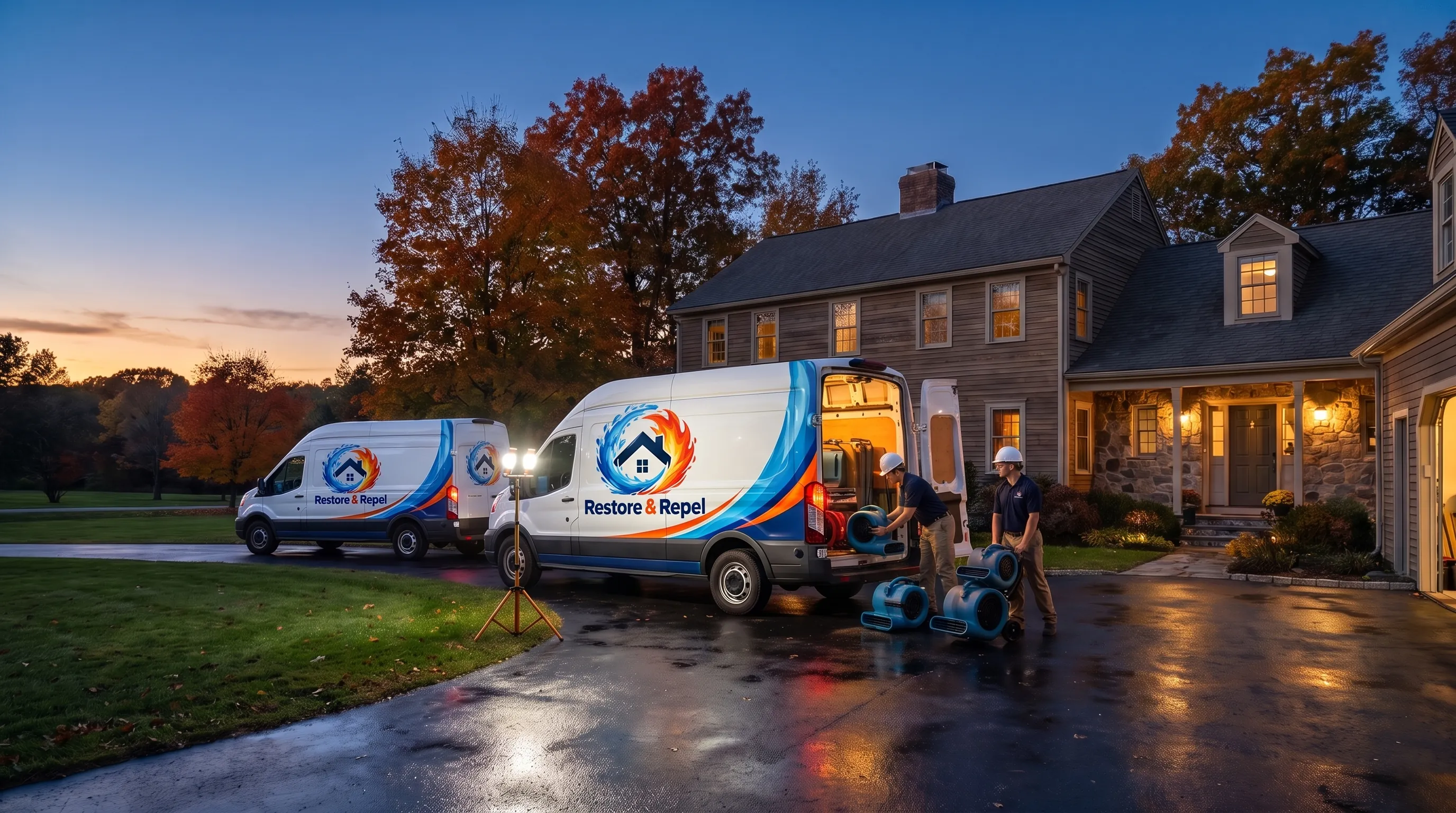
There’s also a documentation benefit. A restoration crew that’s used to working insurance claims will log moisture readings day by day, photograph the affected materials, and produce the kind of paper trail an adjuster actually wants to see, which can be the difference between a smooth reimbursement and a drawn-out back-and-forth. Restore & Repel works directly with homeowners across Topsfield and the surrounding North Shore towns on exactly this kind of documentation, whether the loss is a burst pipe in February or a sump pump failure after a spring downpour.
If the water has been sitting for more than a day, if you can smell a musty odor, or if you’re seeing discoloration spreading across a ceiling or wall, that’s past the point of a DIY fix. Call a restoration company before mold has a chance to establish itself, not after.
The Recovery Process, Realistically
Once the active leak is stopped, recovery generally moves through a few stages. First, extraction: pulling out standing water with pumps and extraction equipment. Second, drying: positioning air movers and dehumidifiers and monitoring moisture content in framing, subfloor, and drywall until readings return to normal, which can take several days depending on how much material absorbed water and what it’s made of. Third, any demolition of material that can’t be dried and saved, like saturated insulation or swollen particleboard cabinetry. Fourth, reconstruction, putting drywall, flooring, and trim back.
Throughout this, your insurance adjuster will typically want to inspect the damage, review the restoration company’s moisture logs, and approve the scope before reconstruction begins. Keep copies of every estimate, invoice, and piece of correspondence. If the claim gets contentious, that paper trail is what protects you.
Water damage rarely announces itself conveniently, and insurance coverage depends on details most homeowners never think about until they’re standing in an inch of water at 6 a.m. If you’re dealing with an active leak or flood in a Topsfield-area home and need help figuring out next steps, documenting the loss, or drying the structure properly, Restore & Repel can be reached at (800) 393-1532.