
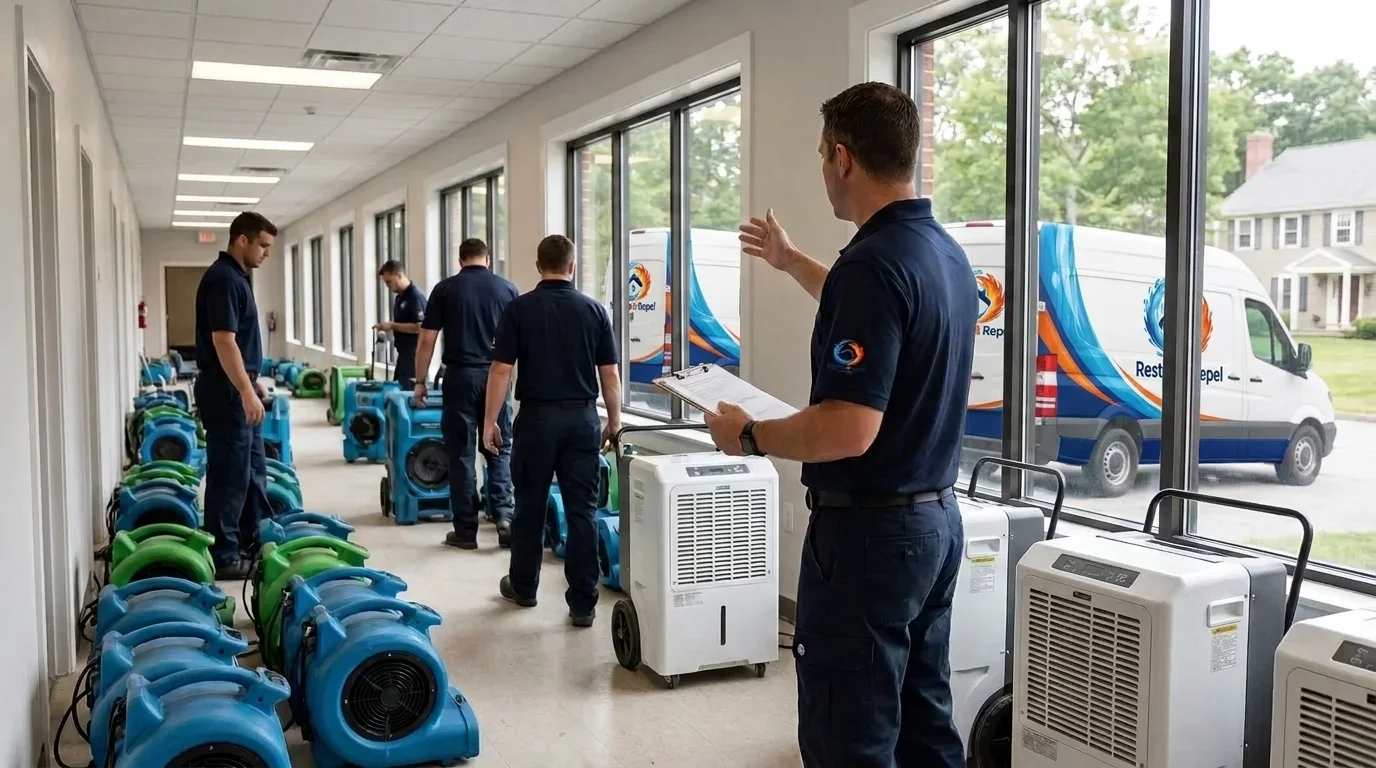
Large Loss and Catastrophic Response in Topsfield
24/7 large loss and catastrophic response in Topsfield and surrounding areas. IICRC-certified, insurance billing accepted. Call (800) 393-1532.
A fire that takes out an entire floor, a burst main that floods a parking garage, a nor’easter that damages three buildings on the same property, these losses don’t fit the scope of a single technician with a few air movers. Large loss and catastrophic response is a different category of restoration: multiple structures or a high-value single structure, round-the-clock crew rotations, and a dollar value that puts insurance adjusters, property managers, and sometimes corporate risk teams in the same room from day one. We answer 24/7 and mobilize additional crews and equipment as the scope demands.
What large loss and catastrophic response actually involves
A large loss is generally defined by the industry as a claim exceeding roughly $50,000, or any loss spanning multiple units, floors, or buildings regardless of the dollar figure. Think apartment complexes after a sprinkler malfunction, hotels after a roof failure during a nor’easter, manufacturing facilities after a pipe burst over a holiday weekend, or a block of commercial units hit by the same storm system. The work itself still rests on the same fundamentals as a standard water, fire, or storm loss, extraction, drying, demolition, soot or contaminant removal, but at a scale that requires a general contractor’s level of coordination: shift-based staffing, generator and desiccant rental logistics, security and site access control, and daily reporting that satisfies both the property owner and the carrier’s large loss unit.
Our process
- Rapid mobilization and triage. We assess every affected structure or unit within the property, prioritize life-safety and water-intrusion hazards first, and establish which areas can be stabilized immediately versus which require engineering or structural input before anyone re-enters.
- Crew and equipment scaling. Catastrophic losses need more than one truck. We bring in additional WRT, FSRT, and AMRT-trained technicians and scale drying or demolition equipment (desiccant dehumidifiers, negative air machines, generators) to match the square footage, not the other way around.
- Documentation built for large loss adjusters. Daily moisture logs, photo and video sweeps of every affected unit, and a running scope-of-work document, because a large loss adjuster is reviewing a file with six-figure exposure and needs a paper trail that matches it line for line.
- Phased mitigation and reconstruction handoff. Work is sequenced by priority (structural drying before cosmetic repair, contaminated materials removed before clean trades move in) so that reconstruction crews can start in completed sections while mitigation continues elsewhere on the property.
- Final walkthrough and carrier close-out. Once drying standards and contamination clearance are met across every affected area, we compile the full file, moisture readings, photos, disposal manifests where applicable, for carrier sign-off.
What separates a good large loss response from a bad one
The most common failure on a multi-unit or multi-building loss is treating it like several small losses instead of one coordinated project. Crews show up without a shared equipment plan, moisture logs get inconsistent between units, and the paper trail falls apart exactly when the adjuster needs it to be airtight. A second failure is underestimating drying timelines on commercial-grade materials, concrete slabs, masonry, built-up roofing assemblies hold moisture far longer than residential drywall and carpet, and pulling equipment too early reopens the claim. Large loss adjusters are specifically looking for consistent daily documentation, a single point of contact managing the whole site, and a scope of work that accounts for business interruption and code-driven upgrades, not just the physical repair.
What does large loss and catastrophic response cost?
Large loss costs vary enormously by structure type, number of units affected, and whether reconstruction is bundled into the same scope. These are typical industry ranges, not a quote, every property is different and Restore & Repel provides a written scope of work before mitigation begins.
| Scenario | Typical range |
|---|---|
| Single-building commercial water loss | $25,000 - $150,000 |
| Multi-unit residential fire loss | $100,000 - $500,000 |
| Large-scale mold remediation across multiple floors | $40,000 - $200,000 |
| Catastrophic storm damage to a commercial property | $150,000 - $750,000 |
| Multi-building or multi-million dollar portfolio loss | $750,000 - $3,000,000+ |
Most commercial property policies cover large loss mitigation and reconstruction, often with business interruption coverage layered in, but sublimits and co-insurance clauses vary by policy, which is why early coordination with the adjuster matters.
Seasonal & regional considerations
Nor’easters and ice-damming events across the North Shore and Merrimack Valley regularly produce multi-building losses at once, several units in the same complex failing within hours of each other as roof loads or frozen pipes give way. Spring thaw brings a second wave as ice dams finally release water that’s been sitting in a roof assembly for weeks. Older mill buildings and multi-tenant commercial properties common across this part of Massachusetts also tend to have outdated plumbing and roofing systems, which raises the odds that one failure cascades into several.
Service area
Restore & Repel is based in Topsfield and responds to large loss and catastrophic events throughout the surrounding North Shore and Merrimack Valley communities, commercial properties, multi-family buildings, and institutional sites alike.
If you’re managing a property with damage spanning multiple units, floors, or buildings, don’t wait for the full extent to surface on its own. Call (800) 393-1532 to start large loss triage and get a coordinated response moving before the claim grows any larger.
Frequently Asked Questions
What qualifies a loss as "large loss" rather than a standard claim?
Does homeowners or commercial property insurance cover large loss restoration?
How is staffing different on a catastrophic loss versus a single-unit claim?
Why does large loss documentation matter more than it does on a standard claim?
Can reconstruction start before mitigation is finished on a multi-building loss?
What happens during the initial triage walkthrough on a catastrophic loss?
Looking for the best large loss and catastrophic response company in Topsfield?
Restore & Repel provides licensed and insured large loss and catastrophic response in Topsfield, MA and the surrounding area, and has served local property owners since 2003. Customers rate us 5.0 out of 5 stars across 2 Google reviews. We answer calls 24/7 — call (800) 393-1532 for immediate help.
Need Large Loss and Catastrophic Response now?
We respond 24/7 across Topsfield and surrounding MA cities.