Industrial Restoration in Topsfield
24/7 industrial restoration in Topsfield and surrounding areas. IICRC-certified, insurance billing accepted. Call (800) 393-1532.
Industrial water damage or fire damage threatening your Topsfield facility? We answer 24/7, and getting equipment and inventory out of standing water or smoke exposure in the first hours matters more in a plant than almost anywhere else. A burst supply line over a production floor, a sprinkler head that discharges into a warehouse rack system, or a fire that smolders through insulation above a manufacturing line doesn’t behave like a residential loss. The square footage is larger, the materials are different, and downtime has a dollar figure attached to every hour.
What industrial restoration actually involves
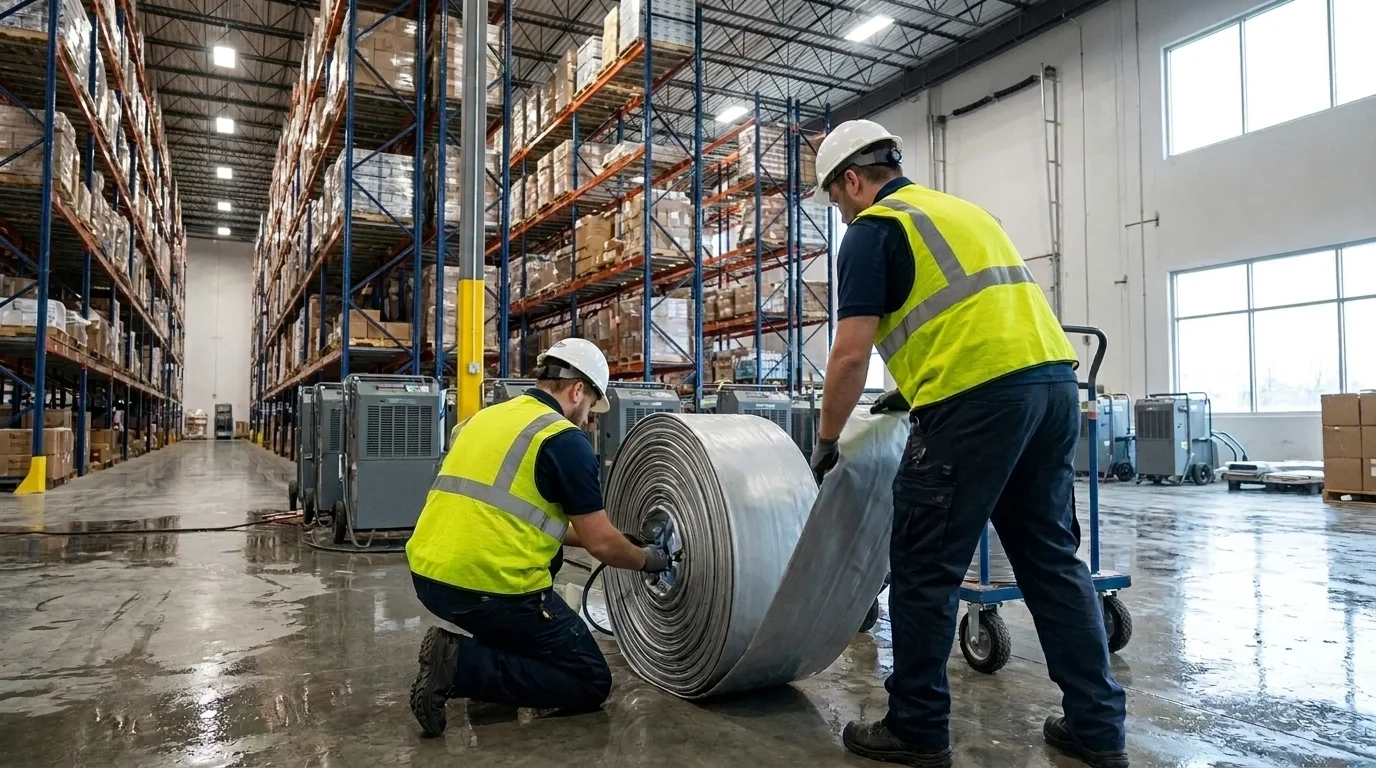
Industrial restoration covers water, fire, and smoke losses inside warehouses, manufacturing plants, distribution centers, and processing facilities, where the building itself is only part of what’s at risk. Concrete slabs, steel structural members, overhead conveyor systems, electrical panels, and process machinery all respond differently to water and heat than residential drywall and framing. Drying a 40,000 square foot warehouse floor requires a different equipment calculation than drying a bedroom, and a fire that reaches cable trays or control panels raises questions residential fire work never touches. Timelines run longer too: industrial drying is often measured in multi-day phases tied to moisture mapping across large slab areas, not a single three-day dry-out.
Our process
- Facility assessment and hazard check. Before any equipment goes in, we walk the affected area with facility management to identify electrical hazards, chemical storage, and any area that needs to stay isolated from production.
- Water extraction or soot/smoke evaluation. For water losses, truck-mounted extraction removes bulk water from floors and low points; for fire losses, we characterize the soot (protein versus synthetic residues burn and settle differently) before choosing a cleaning method.
- Targeted structural drying. Industrial dehumidification and air movement are deployed by zone, often in phases so unaffected parts of the facility can stay operational while we work the affected section.
- Moisture monitoring across the slab and structure. Large facilities need moisture mapping at multiple grid points, not a single reading, because concrete and steel hold and release moisture unevenly across a big footprint.
- Equipment, racking, and contents coordination. Machinery, inventory, and racking are documented and, where needed, coordinated with your equipment vendors or insurance adjuster before cleaning or relocation.
What separates a good industrial restoration response from a bad one
The most common mistake on industrial losses is treating them like an oversized residential job: one dehumidifier placement strategy for a space that actually needs three or four distinct drying zones. Another is skipping moisture readings on concrete and steel because they “look dry,” when both materials can hold moisture well below the surface for weeks longer than drywall ever would. On fire losses, the mistake is cleaning visible soot off walls and ceilings while leaving residue inside HVAC runs or control cabinets, where it corrodes contacts slowly and causes equipment failures months later. Adjusters reviewing industrial claims generally want documented moisture logs by zone, photos of affected machinery and racking before and after cleaning, and a clear explanation of why certain drying equipment was selected for the space, not just a total square footage figure.
What does industrial restoration cost?
Industrial losses vary enormously by square footage, the type of water or fire involved, and whether production equipment is affected, so these are typical industry ranges, not a quote. Restore & Repel provides a written scope of work based on an on-site assessment before any work begins, so you know what’s included before you approve it. Most commercial property policies cover sudden water and fire losses to the structure, and many include business interruption coverage, but equipment and inventory coverage depends heavily on your specific policy.
| Scenario | Typical range |
|---|---|
| Localized water intrusion, under 5,000 sq ft | $5,000 - $15,000 |
| Large warehouse flooding, 20,000+ sq ft | $25,000 - $75,000+ |
| Fire and smoke damage to a production area | $15,000 - $60,000 |
| Equipment and machinery decontamination | $3,000 - $20,000 per line |
| Structural drying with industrial dehumidification (per week) | $2,000 - $6,000 |
Seasonal & regional considerations
Northeast Massachusetts winters bring the biggest risk to industrial and warehouse properties: unheated loading docks, mezzanines, and older sections of a plant are where supply lines and sprinkler risers freeze and split. Summer brings the opposite challenge, since high ambient humidity slows structural drying in large open spaces and can extend the equipment runtime needed to hit target moisture levels. Facilities with older roof systems around Topsfield and the North Shore also see more water intrusion during heavy rain events, especially where flat industrial roofing has aged past its service life.
Service area
Restore & Repel is based in Topsfield and responds to industrial and warehouse properties throughout Essex County, including Danvers, Beverly, Peabody, Ipswich, Wenham, and Boxford. Crews hold IICRC training in water, fire and smoke, and mold restoration, and Restore & Repel operates under Massachusetts license #CS-113-396.
If water or fire has reached your facility, call (800) 393-1532 to get an industrial restoration crew assessing the damage and scoping the work before it spreads further into your structure or equipment.
Frequently Asked Questions
Does homeowners or commercial property insurance cover industrial restoration?
How is drying a warehouse or plant different from drying a house?
Can our facility stay operational while restoration work is happening?
What happens to machinery and electrical panels exposed to water or smoke?
Why does the type of soot matter for industrial fire cleanup?
What documentation should we keep for a business interruption claim?
Looking for the best industrial restoration company in Topsfield?
Restore & Repel provides licensed and insured industrial restoration in Topsfield, MA and the surrounding area, and has served local property owners since 2003. Customers rate us 5.0 out of 5 stars across 2 Google reviews. We answer calls 24/7 — call (800) 393-1532 for immediate help.
Need Industrial Restoration now?
We respond 24/7 across Topsfield and surrounding MA cities.