
TL;DR: In Topsfield, MA, typical water damage restoration costs range from about $1,300 for a single wet room with clean water to $15,000 or more for a basement flooded with contaminated water that needs extraction, structural drying, and a full rebuild. Mitigation (extraction, drying, equipment) and rebuild (drywall, flooring, trim) are priced separately, and the water’s category, how long it sat, and how much square footage it touched drive most of the swing.
If a pipe let go in your Topsfield colonial’s fieldstone basement overnight, or a washing machine line failed in a finished lower level off Perkins Row, you’re probably staring at standing water and wondering what the repair bill looks like before anyone even shows up. The honest answer: it depends on what kind of water it was, how fast it got pulled out, and whether the drywall and flooring survive or need to come out. Here’s how the numbers typically break down for a North Shore home.
How much does water damage restoration cost per square foot?
Mitigation (extraction and drying) typically runs $3 to $7 per square foot, while rebuild work (drywall, insulation, flooring, trim) typically adds another $2 to $10 per square foot depending on the finish level. A basic unfinished basement with a slab floor rebuilds cheaper than a finished family room with hardwood and built-ins.
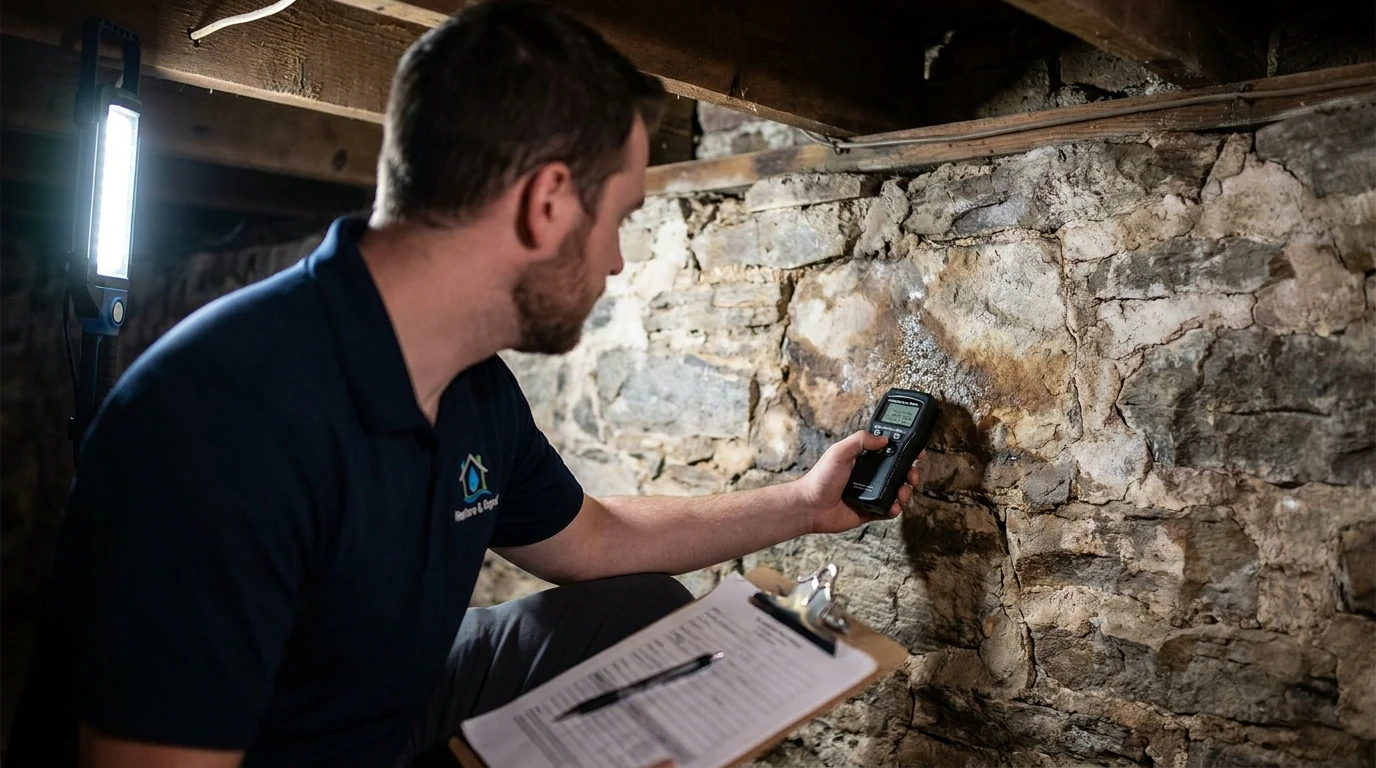
These are industry-typical ranges, not a quote. Older Topsfield farmhouses and colonials with fieldstone or rubble foundations often need extra attention: fieldstone walls hold moisture longer than poured concrete, which can stretch drying time and add equipment days to the mitigation side of the bill.
What does a water damage restoration job typically cost by scenario?
| Scenario | Typical Cost Range |
|---|---|
| Category 1 water, single room, carpet only | $1,300 - $2,800 |
| Category 1 water, finished basement (300-500 sq ft) | $3,000 - $7,500 |
| Category 2 water (gray water), multiple rooms | $4,500 - $9,000 |
| Category 3 water (black water/sewage backup) | $7,000 - $15,000+ |
| Mitigation + drywall/flooring rebuild, single room | $5,000 - $12,000 |
| Full basement mitigation + reconstruction, fieldstone foundation home | $15,000 - $35,000+ |
These figures are typical ranges seen across restoration jobs of similar scope, not a price list. Every loss is different, and Restore & Repel provides a written scope before any work begins.
What drives the cost up or down?
The single biggest factor is water category: Category 1 (clean water, like a supply line) costs far less to mitigate than Category 2 (gray water, like a washing machine overflow) or Category 3 (black water, like a sewage backup), which requires more aggressive demolition and disinfection under the ANSI/IICRC S500 standard.
A few other things move the number:
- Response time. Water sitting for 24-48 hours wicks further into drywall, subfloor, and framing, which means more material removal instead of just drying in place.
- Square footage and layers affected. A single wet carpet pad is cheap. Water that traveled under hardwood, into a finished ceiling below, and behind baseboard in three rooms is not.
- Equipment days. Air movers and LGR dehumidifiers typically run 3 to 5 days to hit dry-standard readings. Fieldstone basements and plaster-walled older homes sometimes need longer monitoring before drywall goes back up.
- Code upgrades. If a rebuild triggers current code (GFCI outlets, updated vapor barrier, egress requirements in a finished basement), that adds to the reconstruction line, separate from mitigation.
- Contents. Cleaning or replacing furniture, flooring underlayment, and insulation adds cost beyond the structural drying.
If you’re not sure which category applies to your situation, our burst pipe emergency checklist walks through the first steps before a crew arrives.
Does homeowners insurance cover water damage restoration in Massachusetts?
Most standard Massachusetts homeowners policies cover water damage that is sudden and accidental, like a burst pipe or failed appliance hose, but exclude damage from long-term leaks, poor maintenance, or ground-level flooding. Flood damage from rising water typically requires a separate NFIP flood policy, since standard homeowners coverage generally excludes it.
According to the Insurance Information Institute, coverage hinges on whether the damage was sudden and accidental versus gradual. A pipe that bursts overnight is usually covered. A slow leak behind a wall that went unnoticed for months often isn’t, because insurers treat that as a maintenance issue.
Deductibles on Massachusetts homeowners policies commonly run $1,000 to $2,500, so a small single-room claim may not clear the deductible once you weigh it against future premium impact. The Massachusetts Division of Insurance oversees how claims are adjusted in the state, and documentation is what protects a claim: moisture readings, photos at every stage, and an itemized scope of work. Our full breakdown is in Does Homeowners Insurance Cover Water Damage?
What’s the difference between mitigation and rebuild, and why does it matter for cost?
Mitigation stops the damage from getting worse and dries the structure; rebuild replaces what couldn’t be saved. Insurers typically treat these as two separate line items on a claim, and understanding that split helps you read an estimate without feeling like you’re being upsold.
Mitigation includes extraction, setting air movers and dehumidifiers, antimicrobial treatment where needed, and daily moisture monitoring until the structure hits dry-standard readings. Rebuild includes drywall, insulation, flooring, trim, and paint, the part that actually makes the space usable again. A job can be mitigation-only (dried in place, no demo needed) or mitigation plus a full rebuild if materials were removed.
What should you do next if you’re facing a water loss right now?
Start with extraction and drying within the first 24 to 48 hours, then get a written scope before committing to rebuild work. Waiting on the mitigation step is what turns a $2,000 job into a mold problem and a $10,000 job, since untreated moisture behind drywall is exactly the condition mold needs to establish.
Restore & Repel employs IICRC-certified technicians (WRT, Water Restoration Technician) based on Boston Street in Topsfield, and documents every job with moisture logs and photos for the insurance file as part of the mitigation process. Request a water damage estimate or start with emergency water removal if water is still active in the home; our reconstruction team picks up once drying is verified.
Getting a number before a crew walks in the door isn’t really possible for water damage the way it is for a roof replacement, because the real cost depends on what’s under the drywall once extraction starts. A written scope after inspection, tied to actual moisture readings, is the only estimate worth trusting.
About Restore & Repel
Restore & Repel employs IICRC-certified technicians (WRT, FSRT, AMRT) based in Topsfield, MA, serving the North Shore since 2003 under Massachusetts license CS-113-396. The company handles water damage restoration, fire and smoke restoration, mold remediation, odor removal, storm damage, roofing, reconstruction, and general contracting for homes and businesses across Topsfield, Peabody, Beverly, Danvers, Andover, North Andover, Middleton, Ipswich, and Boxford.
Need help now? Call Restore & Repel at (800) 393-1532.